
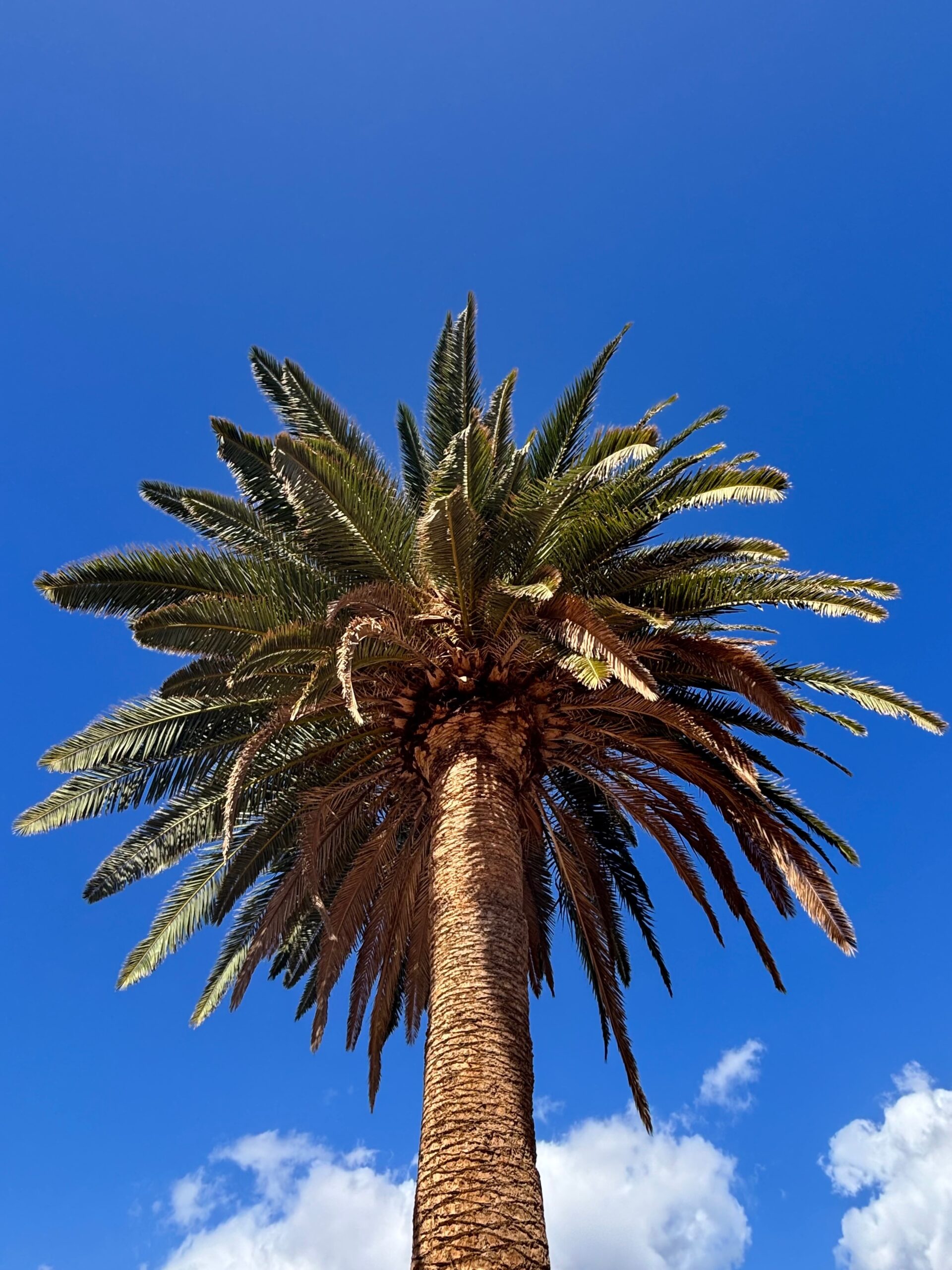
The Canary Island date palm (Phoenix canariensis) is one of the most defining elements of the native flora across the entire Canarian archipelago. As a native, endemic species, it is perfectly adapted to the geographical conditions of the islands and, by law, constitutes the official natural symbol of the autonomous community alongside the Canary bird.
Whether in deep ravines (barrancos), fertile valleys, or as characteristic planting in historic town centers: it is simply indispensable to the landscape and cultural identity of the Canary Islands. Its remarkable resilience makes it not only a keystone of local ecosystems but also a globally valued ornamental plant. But what exactly makes this botanical treasure so special, and what challenges does its preservation face today?
Characteristics and Appearance
Compared to the true date palm (Phoenix dactylifera), the Phoenix canariensis is characterized by a significantly more massive, stouter trunk. This trunk grows straight upwards and can reach over 20 meters in mature specimens. The characteristic diamond-shaped bark structure is formed by pruning and the natural shedding of old leaf bases.
Its densely grown crown consists of numerous pinnate fronds that can grow up to six meters long. Although the plant produces bright orange date panicles, the fruits are significantly smaller, more woody, and barely edible compared to standard commercial dates. Traditionally, they serve primarily as livestock feed as well as a food source for native bird species.
Cultural Significance: “Miel de Palma” on La Gomera
The Phoenix canariensis plays a particularly special role on La Gomera. There, a traditional form of sustainable palm harvesting has been practiced for centuries: the extraction of palm sap, also known as guarapo.
To do this, so-called guaraperos carefully cut into the heart of the palm in the evening. The sap that seeps out overnight is collected the next morning and boiled down over a wood fire for hours. The result is Miel de Palma (palm honey) – a dark, aromatic syrup that is a staple of the regional gastronomy. With proper extraction, the palm suffers no permanent damage and fully regenerates after a resting period of several years.
Global Distribution and Adaptability
Due to its resilience and striking growth, the Phoenix canariensis has been established worldwide as an ornamental plant. It is considered extremely drought-resistant, makes few demands on soil conditions, and can briefly tolerate temperatures down to about -8 °C. Today, it can be found in many Mediterranean and subtropical regions – including Southern Europe, California, South America, and Australia.
Threats and Protective Measures
Despite their natural robustness, the populations face biological challenges. The greatest danger comes from the Red Palm Weevil (Rhynchophorus ferrugineus), a pest whose larvae infest the inside of the palm heart and destroy the plant if left untreated. Additionally, fungal diseases like Fusarium wilt afflict the trees. Therefore, strict quarantine and transport protection regulations for plant material apply in the Canary Islands to sustainably secure the native population.